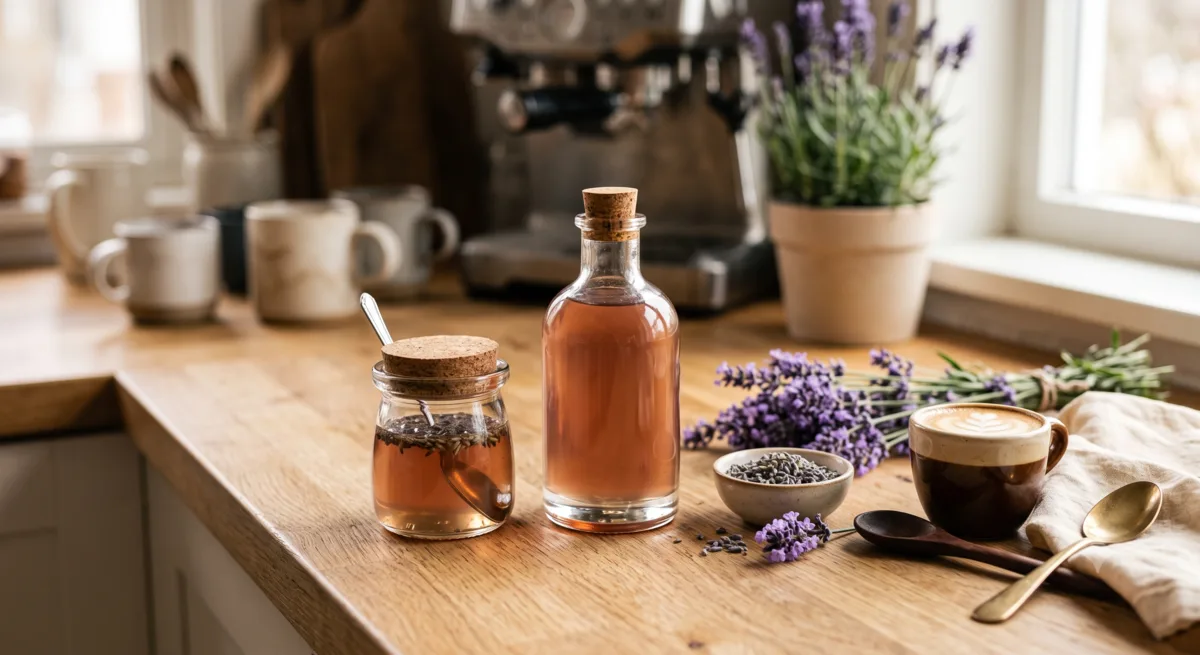
 SYRUPSAI-generated illustration
Lavender Syrup
The quick answer
Combine 1 cup of sugar and 1 cup of water in a small saucepan with 2 tablespoons of dried culinary lavender. Bring to a gentle simmer over medium heat, stir until sugar dissolves (about 3 minutes), then remove from heat and steep for 20 minutes. Strain through a fine mesh sieve.
Worked example for this recipe
Lavender Syrup: these rows scale this card’s own ingredient inputs and convert its specified liquids with the site’s volume calculator. Ranges and solid ingredients are scaled without assigning a liquid volume. Water and flavoring input volumes are not finished syrup yield; dry sugar is not treated as a liquid. Cup conversions use the approximate 236.6 mL convention.
| Ingredient input | 1× recipe | 2× recipe | 1× liquid conversion |
|---|---|---|---|
| granulated sugar | 1 cup granulated sugar | 2 cups granulated sugar | Not converted to liquid volume |
| water | 1 cup water | 2 cups water | ≈ 236.6 mL |
| dried culinary lavender | 2 tablespoons dried culinary lavender | 4 tablespoons dried culinary lavender | Not converted to liquid volume |
Culinary lavender is the essential ingredient. Look for culinary lavender or food-grade lavender at specialty grocery stores, Whole Foods, or online from Starwest Botanicals.
The 1:1 ratio of sugar to water (equal parts by volume) produces a standard simple syrup consistency. This dissolves readily in both hot and cold drinks. For a thicker syrup that coats a spoon, use a 2:1 ratio (2 cups sugar to 1 cup water), but this is typically unnecessary for coffee drinks.
Steeping time is the main variable affecting flavor intensity. A 20-minute steep produces a balanced floral flavor. Steep for 30 minutes for a stronger lavender taste. Beyond 30 minutes the syrup can turn slightly bitter and medicinal. Start with 20 minutes and adjust based on your preference and the strength of your lavender.
Make it
Makes 1 batch (1 cup water input) — measure the finished yield
Ingredient amounts and alternate units scale together. Times, temperatures and device sizes stay unchanged; use multiple batches or vessels when needed. Ingredient amounts in the steps scale with the list.
Ingredients
Steps
Preparation notes
- Use culinary or food-grade lavender only. Non-food lavender tastes soapy and may be unsafe to consume.
- Do not boil the syrup aggressively -- a gentle simmer is enough to dissolve the sugar without cooking off the lavender's volatile aromatics.
- Add 1/4 teaspoon of vanilla extract to the finished syrup for a lavender-vanilla combination that works especially well in lattes.
- Start with 1 tablespoon of syrup per drink and adjust upward. Lavender flavor is easy to overdo in coffee.
Was this page helpful?
Private feedback stored only in this browser; it is not sent to Home Cafe Lab.
Frequently asked questions
Where can I buy culinary lavender?
Culinary lavender is available at Whole Foods, specialty spice shops, and farmers markets. Online, Starwest Botanicals and Mountain Rose Herbs sell food-grade dried lavender. Avoid any lavender sold for non-food purposes -- it may contain additives that taste soapy or are not food-safe.
How much lavender syrup should I put in coffee?
Start with 1 tablespoon per 8 oz drink and adjust to taste. Lavender flavor intensifies as a drink cools, so a latte that tastes balanced hot can become quite floral as it cools. When in doubt, start with less -- you can always add more.
Can I use fresh lavender instead of dried?
Yes, but use twice the amount -- 4 tablespoons of fresh lavender per cup of water. Fresh lavender has a higher moisture content and slightly more volatile aromatics, so reduce the steep time to 15 minutes to avoid an overpowering floral flavor. Dried lavender is more consistent and easier to measure accurately.
What drinks can I use lavender syrup in?
Lavender syrup works in lattes (hot or iced), lemonade, sparkling water, matcha, and Earl Grey tea. It pairs especially well with vanilla, honey, and citrus flavors. In coffee drinks, it works best in lighter roasts -- dark roast coffee's bitterness can clash with the floral notes.

Written by
Hommer Zhao
Hommer Zhao is the founder and general manager of Home Cafe Lab. He runs the site and is responsible for its recipes, calculators and guides.
View profile →Make these next
Get the Home Cafe Ratio Sheet
Every core ratio — cold foam, cold brew, latte, matcha, syrup — on one printable page. Free. No email needed, just print it.
Open the free ratio sheet →